$ blog / risck-analysis-pipeline
Back to indexThe RISCK: Analyzing a Time-Scramble Tactic in 64,000 Lichess Games
Does hanging a full piece in a 4-second time scramble actually help you win? I analyzed 64,000 Lichess games to prove the mathematical lethality of online chess's most controversial tactic: the RISCK.
Introduction
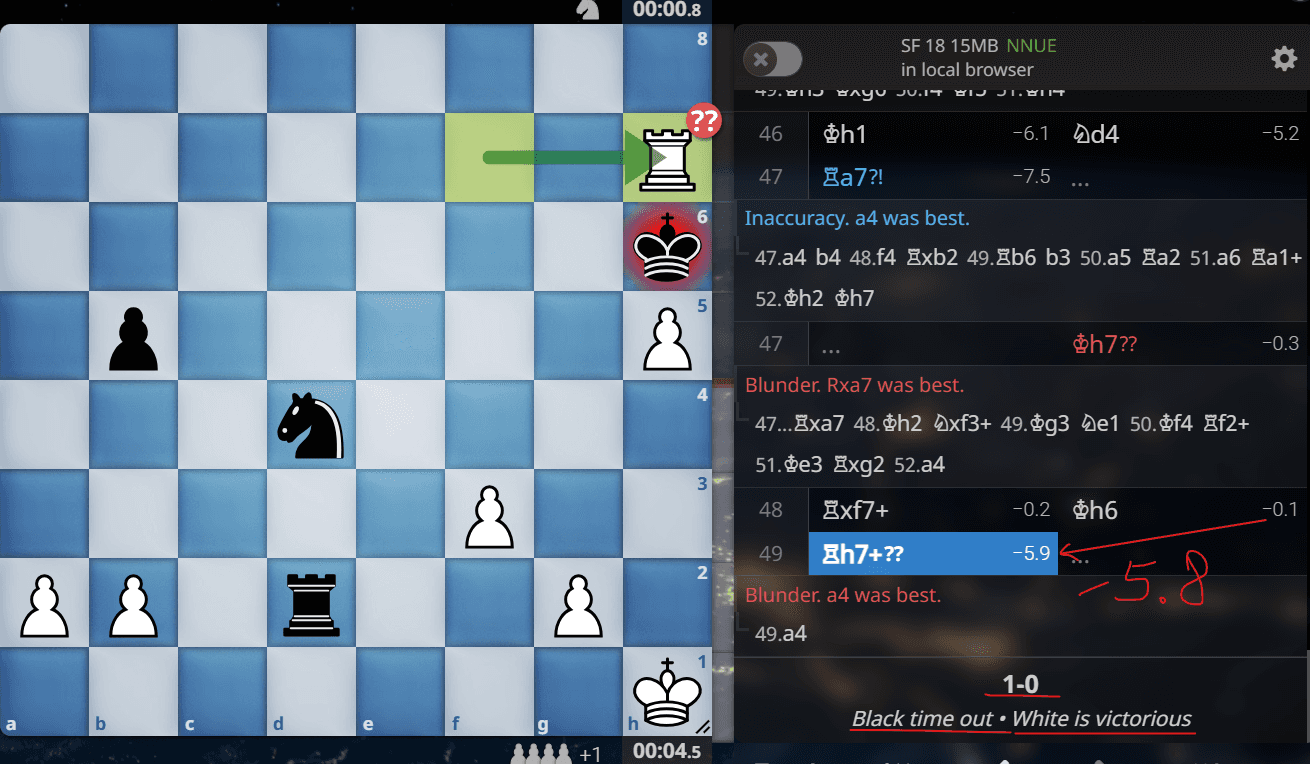
Imagine a scenario where both players have 4 seconds left on the clock, fighting for their lives and bombarding nonsensical pre-moves just to win on time. This chaos happens quite often in online chess, and it breeds highly controversial time-scramble tactics.
For the past few weeks, I have been researching one specific tactic that occurs much more often than the chess community openly discusses. I couldn’t find an existing term that accurately described it, so I coined one myself: RISCK, which stands for Random Inferior Sacrificial Check to King (yes, that takes a while to read).
It is pretty self-explanatory: imagine that same 4-second scenario where both players are making random pre-moves with the sole focus of landing on legal squares. Instead of playing along, one player bamboozles their opponent by throwing a completely random, mathematically inferior, sacrificial check directly at the opponent's king using an active piece like a Rook or a Queen. As a result, if the opponent successfully gets affected by this baffling move, the checking player might gain a massive time advantage.
If you are a crazy online speed chess (with no time increment) player like me, you probably already know exactly what I am talking about. So today, I would like to share some of my interesting preliminary findings to make the chess community aware of the real, mathematical impact of this tactic.
The Lethality
The Baseline
In a messy time scramble—whether it’s a chaotic middlegame or a tense endgame, and regardless of who is slightly better or worse on the board—standard chess principles often go out the window. Players mostly rely on pure instinct to keep their flag from falling. To understand the impact of a RISCK, we first have to understand the power of a normal check.
I ran a control group of 64,500 Lichess games where a player delivered a mathematically sound, logical check under 5 seconds. The data shows that the checking player wins a staggering 82.52% of the time in these situations. This incredibly high win rate might suggest that delivering a sound check under extreme time pressure is highly effective, possibly because it forces the opponent to manually react and disrupts their pre-move flow, though it is hard to know exactly what goes through a player's head.
RISCK Win Rate:
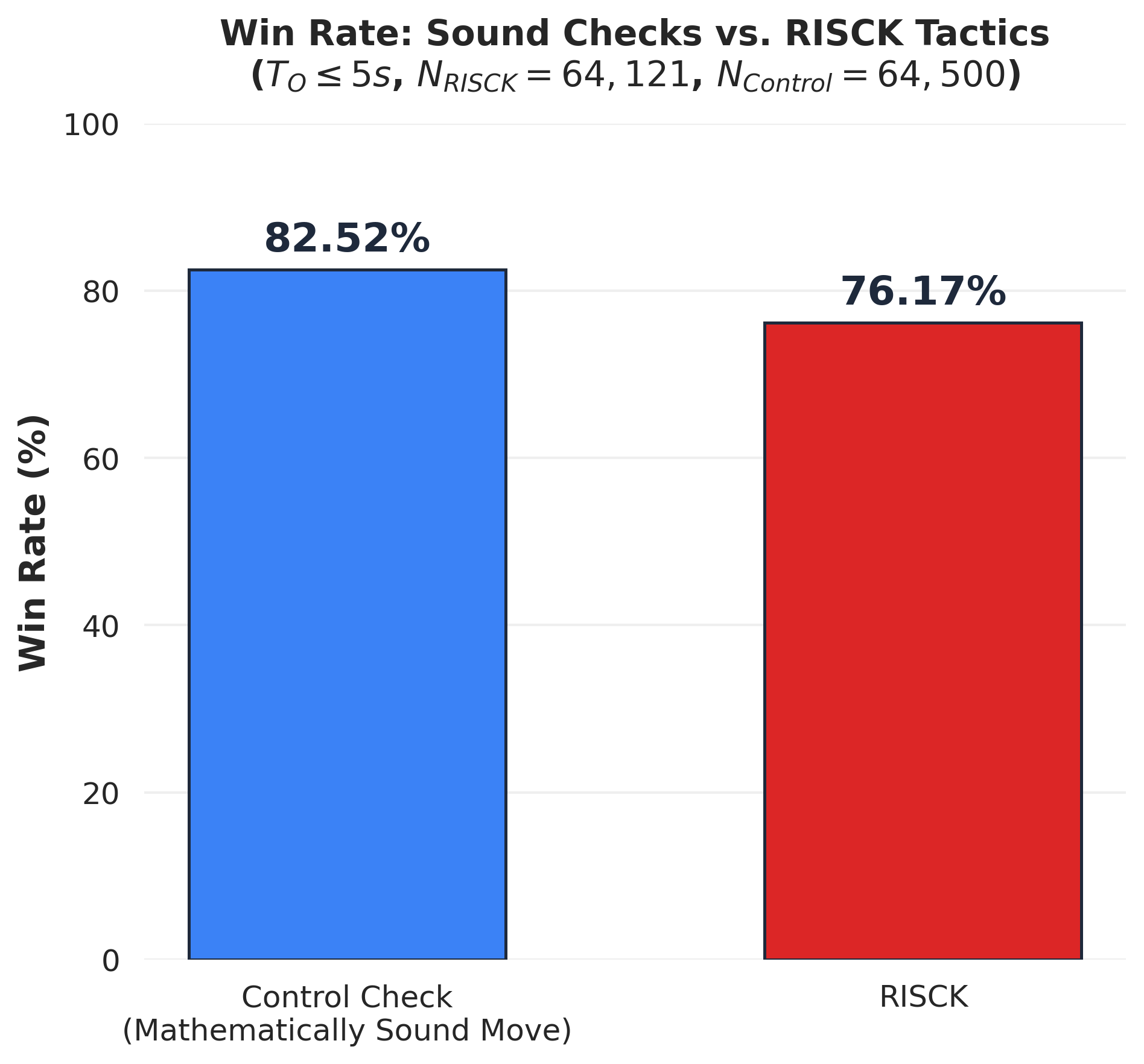
But what happens when you completely break the rules of chess and play a RISCK-y move? I ran a dataset of over 64,000 verified games where a player under 5 seconds deliberately played a RISCK—a check with an objective evaluation drop of at least -400 centipawns (a massive material blunder, like hanging a Rook).
In normal chess, hanging a major piece typically plummets your chances of winning to near zero. But in a sub-5-second scramble? Dropping a free piece directly next to your opponent's king still yields a massive 76.17% win rate.
This reveals the ultimate paradox of online speed chess. In a time scramble, the objective quality of your chess moves might not matter as much as one would think. It appears that the sheer disruptive nature of delivering a check can be so impactful that even if you intentionally throw away your most valuable piece, you might only lose about 6% of your statistical winning edge. The clock becomes the only piece on the board that matters.
The Mechanics Behind the Move
So, why does hanging a piece actually work? You might expect a move this absurd to make the opponent pause, freeze, and realize they are being gifted a free piece.
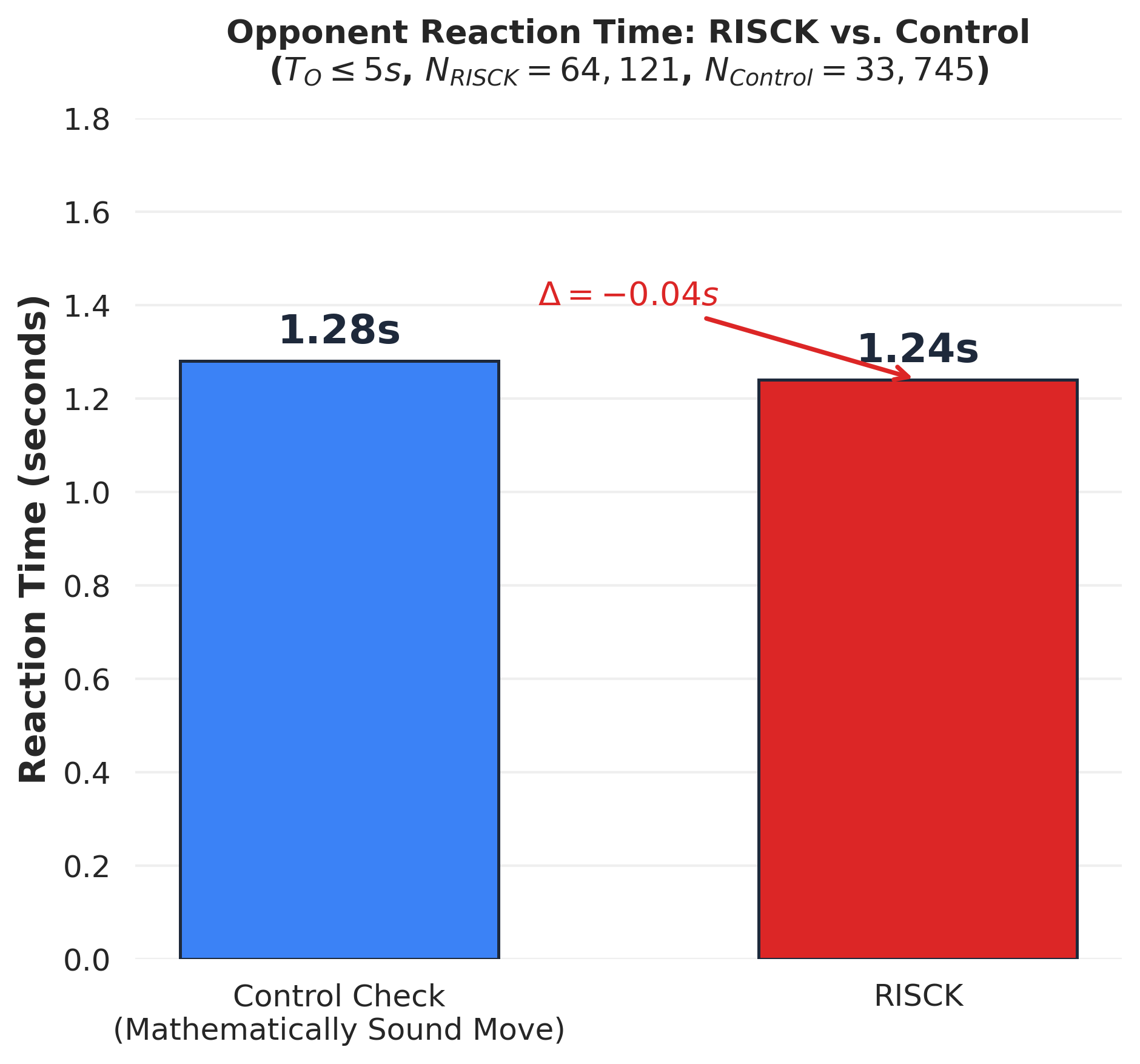
Interestingly, the data suggests that a "baffle freeze" might not exist in a time scramble. In sub-5-second situations, players react to a normal, mathematically sound check in an average of 1.28 seconds. When hit with a RISCK in that exact same time crunch, their reaction time is almost identical, clocking in at 1.24 seconds.
This statistical similarity indicates that players likely do not freeze to calculate the absurdity of the move; they simply react. So, if they are capturing your free piece at the same speed they would react to a normal move, why does the RISCK still yield a 76% win rate?
Based on my experience as a player, this phenomenon might come down to a few practical factors:
- Pre-move Cancellation: In a desperate scramble, players survive by heavily relying on pre-moves (which consume 0.0 seconds on Lichess). When you suddenly deliver a check, the platform invalidates whatever safe move they had queued up. This cancellation forces the opponent to use their actual, ticking clock to respond.
- The Time-Bleed: The data shows it takes players an average of 1.24 seconds to capture the RISCK piece. In a sub-5-second situation, burning 1.24 seconds just to manually process and capture a piece is still a massive penalty—it consumes a significant portion of their entire remaining clock.
- The Asymmetry: Because the RISCK player expects the capture, they can safely pre-move their next response that takes 0.0 second. The RISCK essentially acts as a time-thief: it breaks the opponent's 0.0s pre-move flow and forces them to bleed fatal amounts of real clock time while the attacker maintains their pre-move momentum.
Methodological Limitations & Platform Variance
To maintain rigorous bounds on these conclusions, I must note several platform-specific constraints regarding our data source:
- Lichess Clock Architecture: Lichess utilizes a distinct time-handling system (e.g., allowing exactly one pre-move that consumes 0.0 seconds, alongside specific network lag compensation). Our reaction time metrics inherently absorb these platform-specific mechanics.
- Generalizability (The 0.1s Chess.com Variable): Competitor platforms like Chess.com handle time scrambles differently (e.g., allowing multiple queued pre-moves that consume 0.1 seconds each). It is highly probable that conducting this exact statistical analysis on Chess.com data would alter the behavioral mechanics and yield different reaction times between a RISCK and a control check.
- Data Availability Constraints: Validating this platform variance mathematically requires cross-referencing datasets. However, unlike Lichess, Chess.com does not provide public, open-source bulk databases of their games, currently restricting this analysis to a single platform’s ecosystem.
How to Weaponize It (Takeaways)
I am not telling you to go out and hang your pieces in every game; it is RISCK-y after all. However, if you want to use this data for your bullet/blitz games, here is a practical takeaway: pay attention to the clock.
If your opponent has 15 seconds left, do not try a RISCK. Fifteen seconds is an eternity in speed chess—it is enough time for them to process the absurdity of the move, capture your free piece, and win the game. But if you drag them down into the mud where the clock reads 4 seconds, the dynamics change. Embrace the chaos when you play a RISCK on the board, and see if the statistics works in your favor.
Methodology Appendix
For the data scientists and chess developers, here is how the 76% win rate was calculated:
- Data Source: Raw Parquet databases from February, March, and April 2026 via Thomas Daniels' Aix-compatible Lichess repository (approx. 45GB of game data).
- Environment: All processing was executed on a High-Performance Computing (HPC) cluster utilizing a read-only Nix package environment.
- Phase 1 Filter (SQL): DuckDB CLI was utilized to scan millions of Lichess games and isolate situations matching extreme time pressure (Opponent Clock <= 5s) and an objective major blunder (Evaluation Drop <= -400cp).
- Phase 2 Filter (Python): python-chess was used to mathematically rebuild the board states of candidate games to verify geometric adjacency (the checking piece was placed directly next to the king) and capturability (the checking piece was completely undefended).
- Sample Size: The final aggregated pipeline isolated a robust N = 64,121 verified, true RISCK occurrences.